

Report By Harpal Singh Flora
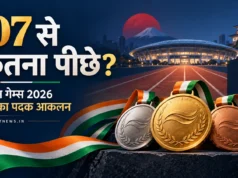
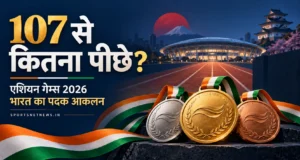
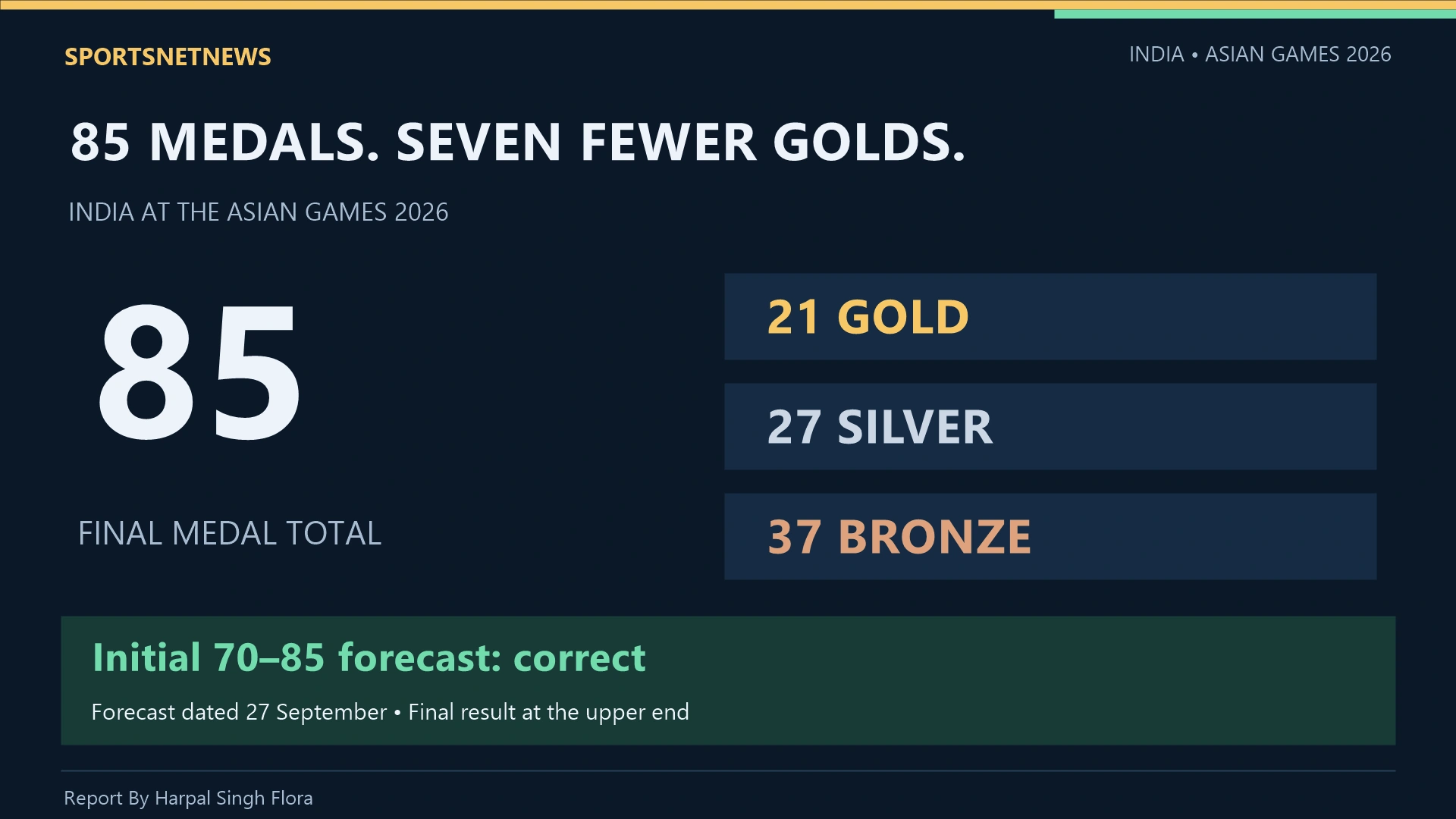
India finished the Asian Games 2026 with 85 medals: 21 gold, 27 silver and 37 bronze. Fourth place was retained, but the total fell sharply from Hangzhou. Harpal Singh Flora’s initial 70–85 prediction, made on 27 September, matched the final result at its upper end. The later 1 October revision of 73–82 underestimated the finish; an honest assessment must record both.
The official final standings put India and Uzbekistan on 21 golds each. India’s 27 silvers against Uzbekistan’s 25 secured fourth place. The ranking alone, however, does not describe the performance.
107 or 106? Getting the comparison right
Hangzhou, held in 2023, originally yielded 107 medals: 28 gold, 38 silver and 41 bronze. Boxer Parveen Hooda’s bronze was subsequently disqualified following an International Testing Agency decision over three whereabouts failures. The revised baseline is therefore 106: 28 gold, 38 silver and 40 bronze.
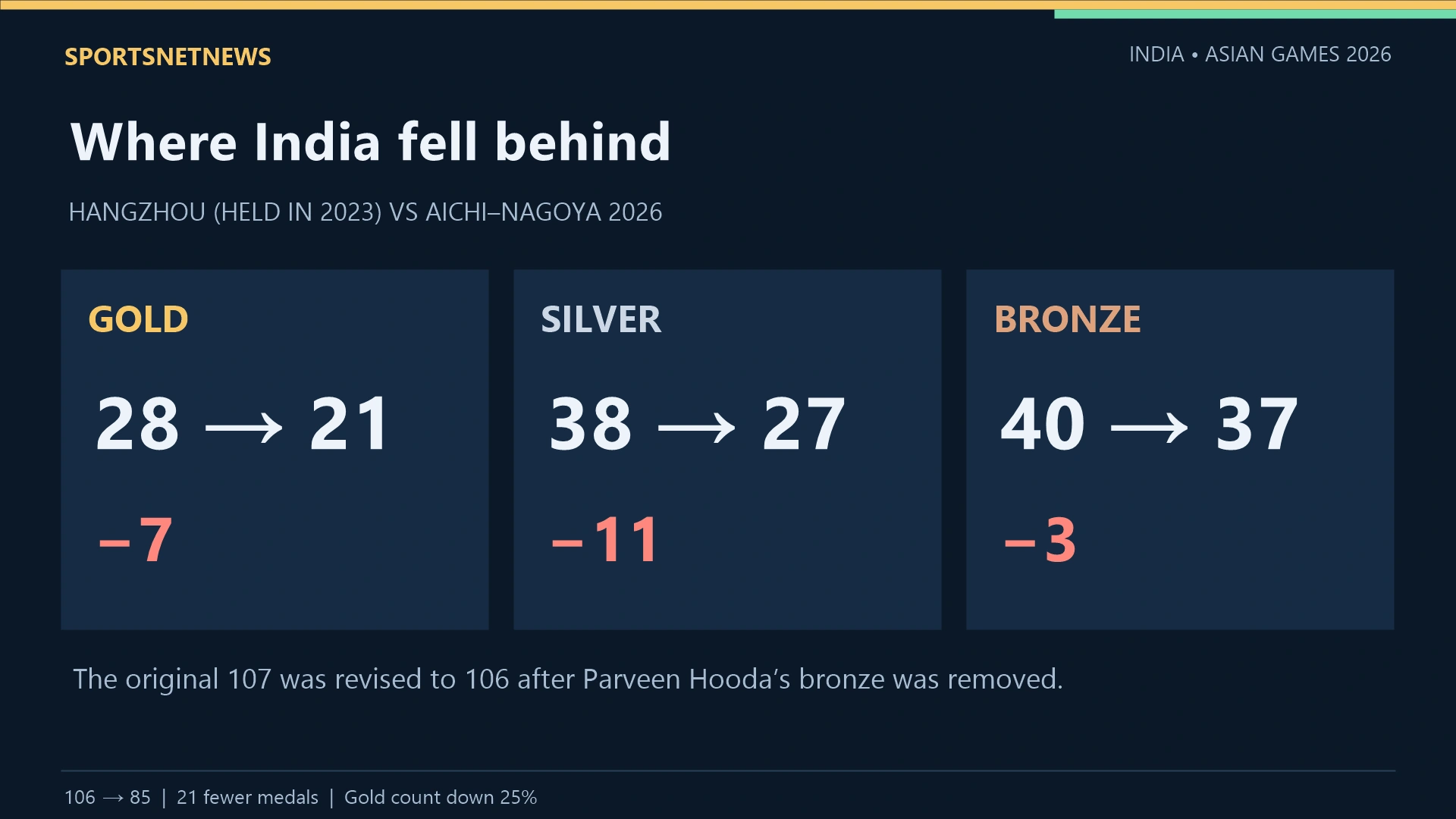
Against that revised figure, India lost 21 medals—seven gold, 11 silver and three bronze. Compared with the original 107 headline, the difference is 22. Total medals fell 19.8%; golds fell 25%. Gold and silver combined dropped from 66 to 48.
How the running total reaches 85
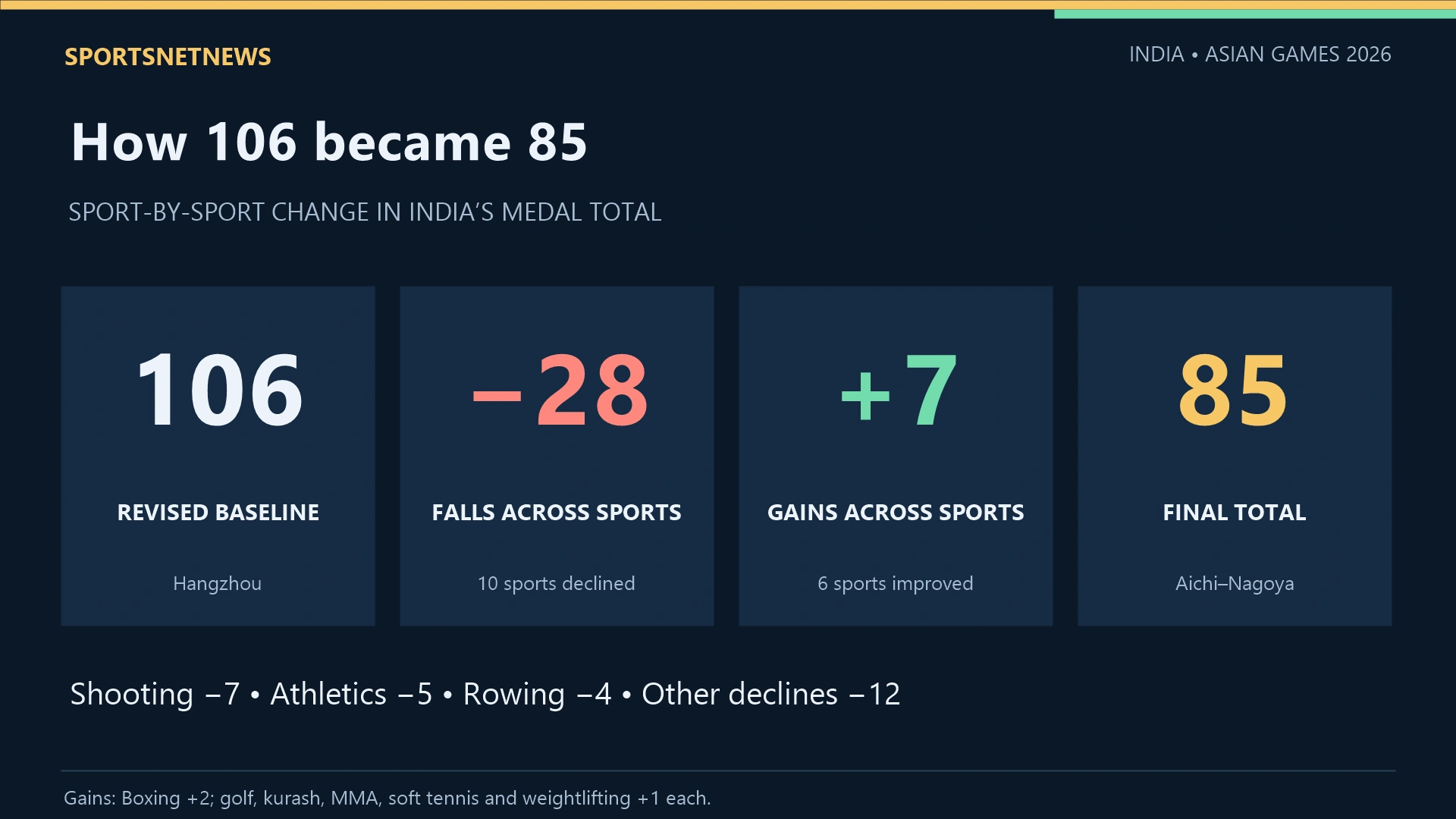
The ledger below starts at the revised Hangzhou total and applies each sport’s change once. Its running totals explain the comparison; they are not the order in which India won medals in Japan.
| Step | Change | Running total |
|---|---|---|
| Revised Hangzhou baseline | — | 106 |
| Chess, bridge, roller skating absent | −5 | 101 |
| Shooting: 22 → 15 | −7 | 94 |
| Athletics: 29 → 24 | −5 | 89 |
| Rowing: 5 → 1 | −4 | 85 |
| Badminton: 3 → 1 | −2 | 83 |
| Equestrian and tennis: two each → zero | −4 | 79 |
| Canoe sprint: 1 → 0 | −1 | 78 |
| Boxing: revised 4 → 6 | +2 | 80 |
| Golf: 1 → 2 | +1 | 81 |
| Kurash, MMA, soft tennis, weightlifting: one each | +4 | 85 |
Sports that declined lost 28 medals collectively. Gains elsewhere recovered seven, leaving the net reduction of 21. Sports omitted from this ledger had unchanged totals, although their medal colours sometimes changed substantially.
How programme changes affected medal opportunities
Chess, bridge and roller skating supplied five previous medals. Three further Hangzhou podiums came in events unavailable in the same form: men’s rowing eight silver, men’s canoe double 1,000m bronze and mixed-team 35km race-walk bronze. Canoe sprint continued, including men’s C2 500m; rowing’s lightweight double sculls also remained.
That makes eight historic medal credits: four silver and four bronze. They are already included in the ledger, so subtracting them again would double-count the decline. Nor were they eight guaranteed repeat medals.
Events new or restored relative to Hangzhou supplied three Indian medals: MMA bronze, mixed 4×100m relay bronze and mixed-team trap gold. These are already inside the 85. Mixed skeet was present in Hangzhou, and shooting team events were retained; their supposed removal cannot explain shooting’s seven-medal fall. None of the eight unavailable previous credits was gold, so that accounting alone cannot explain seven fewer golds.
Fewer golds—and progress hidden inside unchanged totals
Athletics went from 6 gold, 14 silver and 9 bronze to 1 gold, 9 silver and 14 bronze. Its 24 medals came within one of the 25-medal expectation conveyed by the Athletics Federation of India to Sportsnet. That proximity should not obscure the fall in victories.
Wrestling kept six medals but improved from zero golds to two. Hockey converted a gold and bronze into two golds. Squash again won five medals, but lost its previous two golds. Archery retained nine medals and five golds: recurve improved from two medals to five, while compound fell from seven to four. Kumkum Anil Mohod’s individual title and the women’s recurve team gold were significant breakthroughs.
Fourth places: which margins really were small?
- Women’s 4×100m: India’s 43.57 seconds trailed Japan’s bronze time by 0.05 seconds—one twentieth of a second.
- Shaili Singh, long jump: 6.42m against bronze at 6.46m, a four-centimetre gap.
- Asha Ilango, triple jump: she and bronze medallist Li Yi both reached 13.83m; their next-best attempts decided the tie.
- Women’s air pistol team: India and Vietnam scored 1,719; Vietnam’s 46 inner tens against India’s 44 settled bronze.
- Tilottama Sen, rifle three positions: the same elimination stage showed 337.3 against Kim Ji-eun’s 338.1—a 0.8-point gap.
These comparisons identify preparation priorities. They do not justify retrospectively adding medals. Shooting margins must compare equal numbers of shots, not an eliminated athlete’s score with a medallist’s later total.
Other fourth places need different interpretations. Dhiraj Bommadevara lost the recurve bronze match to Indian teammate Neeraj Chauhan; Ankita finished behind India’s Parul Chaudhary in the steeplechase. Swapping either pair would not increase India’s total. Balraj Panwar’s single-sculls gap to bronze was 8.02 seconds—not a photo finish. Improving an existing silver to gold would also change medal colour, not the total.
Federation disputes, selection and missed opportunities
The Asian Handball Federation confirms India’s women withdrew before the draw. A Times of India report linked the entry problem to rival Indian bodies. Withdrawal is established; the factionalism explanation remains attributed reporting. India had finished fifth in Hangzhou, so this was a lost competitive opportunity, not proof of a certain medal denied.
In men’s rapid-fire pistol, NRAI selected only Anish Bhanwala, preventing a three-shooter team entry in a previous bronze-winning event. The New Indian Express reported that other events received priority within the 15-men/15-women limit. That selection trade-off merits review; it does not itself prove factionalism.
Rowers questioned late crew changes; RFI defended them as coaching decisions responding to a reduced programme. Both accounts require examination. The five-to-one decline cannot establish an administrative medal cost, especially with men’s eight removed.
Other concerns also require precise language: India participated in gymnastics and karate, despite reported selection and coaching-support issues. Equestrian selection complaints do not establish proven bias. Across these cases, available evidence does not quantify how many medals federation conflict cost India.
New breakthroughs and the Olympic opportunity
Suchika Tariyal won bronze in debut discipline MMA. Jay Meena delivered India’s first soft-tennis medal in an existing sport. Pranavi Sharath Urs won India’s first women’s individual golf gold—not India’s first golf gold. These successes warrant regular competition, specialist coaching and pathways for younger athletes.
Both hockey teams qualified for LA28 through their titles. Archery secured a women’s individual recurve quota and the compound mixed-team quota. Archery places belong to India; final athlete selection remains separate.
Investment must follow the actual Olympic programme. Compound offers mixed team; squash offers men’s and women’s singles. Cricket’s Asian Games golds do not automatically confer Olympic qualification. Trap mixed is included, skeet mixed is not. Three-person air pistol teams and lightweight double sculls are absent from LA28, as are MMA and soft tennis. Their Asian Games development still matters, but an Asian fourth place cannot be converted directly into an Olympic medal forecast.
Government and federations should publish selection criteria and scores, settle appeals before entries close, establish combinations early and secure essential coaches. Technical reviews should distinguish tiny margins from larger international performance gaps. India’s 85 medals provide evidence for that work: more podiums matter, and so does converting them into victories.
Method: Final results checked on 5 October 2026. Each individual, pair or team podium counts once. Comparisons use the revised Hangzhou baseline. Administrative allegations remain attributed; recommendations are editorial analysis.